
Sulcus vocalis – what is it?
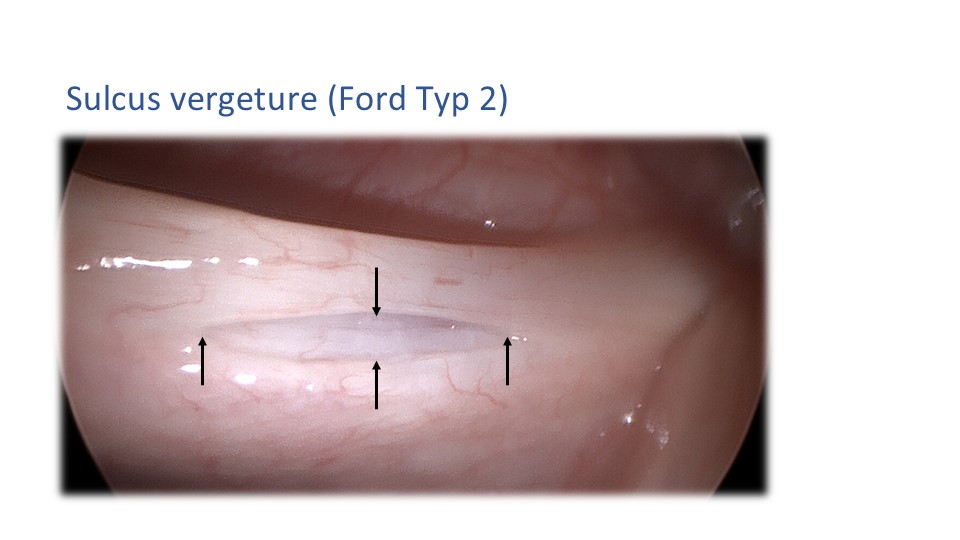
A Sulcus vocalis is a ‘groove’ in the vocal fold epithelium that runs parallel to the axis of the vocal folds and restricts the mobility of the mucous membrane. It can occur on one or both sides. The voice is hoarse and strained, usually with a higher-pitched speaking voice.
Diagnosis during endoscopy under local anesthesia is only possible with a specialized examination technique and high-resolution optics. The treatment of a sulcus is difficult, requires considerable experience, and often does not lead to a return to normal vocal function. Less pronounced changes are often only diagnosed during an examination under general anesthesia, when the vocal folds can be palpated with instruments. Sometimes further signs of a malformation can be found during this process, such as a ‘mucosal bridge’ or an epidermoid cyst.
Why the diagnosis is often overlooked
Diagnosis can be particularly difficult in cases of superficial sulci. At rest, the vocal fold often appears almost normal. It is only during vibration that the characteristic changes become visible
-
longitudinal groove along the edge of the vocal fold
-
reduced edge mobility
-
reduced vibration amplitude
-
oval glottic opening
-
asymmetrical vibration patterns
For this reason, stroboscopy remains the diagnostic gold standard. In professional singers in particular, significant functional limitations are often already evident, even though the morphological changes appear comparatively subtle at first glance. Palpation is always helpful for diagnosis. This reveals the sulcus and its extent. In the treatment chair, with a little practice, this palpation can also be performed under topical spray anesthesia using a catheter via a transnasally guided flexible scope with a working channel
The cause of sulcus vocalis is not fully understood. In many cases, it appears to be a congenital abnormality or a genetic predisposition. A familial clustering of the condition is particularly evident in Eastern countries, from Turkey to India. The voice disorder may not manifest until adulthood, or at least may not become clearly apparent until then.
Why is treatment so difficult
The treatment of a sulcus differs fundamentally from that of recurrent laryngeal nerve palsy or presbyphonia. With a sulcus, the problem lies deeper. Augmentation using hyaluronic acid, autologous fat or calcium hydroxylapatite has been employed. The aim was simple: to improve glottic closure by increasing volume. However, even if the glottic gap is successfully closed completely, the vibration disorder of the lamina propria and the stiffness of the vocal folds persist. Although the voice often improves following medialisation, it rarely achieves the quality of a healthy vocal fold.
A promising alternative: testosterone injection
A local injection of testosterone into the vocal folds (off-label) leads to structural changes in the vocal fold tissue and an alteration in the sound of the voice. It is assumed that the androgenic effect increases muscle mass and lamina propria tissue volume, as well as induces trophic changes in the mucosa, which manifest physically as alterations in the biomechanical properties of the vocal folds.
This can be used to treat a sulcus. A testosterone injection (administered several times at intervals of a few weeks) can lead to improved glottic closure, easier vibration of the vocal folds, and a reduction in breathy voice quality. A previously published case report also described improvements in maximum phonation time, subjective voice quality and stroboscopic findings.
However, because the evidence currently relies on individual case reports, the method’s efficacy remains insufficiently substantiated. Its role in the treatment of sulcus should still be classified as experimental.
From Reconstruction to Regeneration
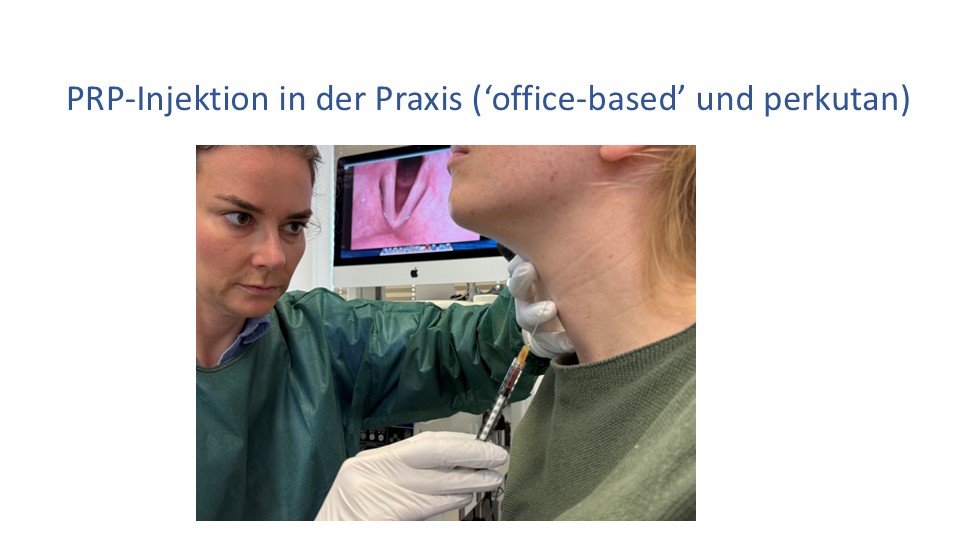
Progress in regenerative techniques is particularly promising. Conventional phonosurgery aims to compensate for the effects of the sulcus. Regenerative medicine pursues a different goal: to repair the damaged lamina propria at a biological level. This may well be the future of sulcus therapy. In recent years, the use of platelet-rich plasma (PRP) injections into the vocal folds has attracted particular attention. PRP is derived from the patient’s own blood and contains high concentrations of various growth factors