

PRP for the Voice – Regeneration of the Vocal Folds in Cases of Scarring, Sulcus, and Atrophy
Platelet-Rich Plasma (PRP) – What is that?
Platelet-Rich Plasma (PRP) is an innovative, biological therapeutic procedure that is increasingly being used to treat voice disorders. In this procedure, a highly concentrated plasma rich in growth factors is extracted from the patient’s blood. These growth factors specifically promote the regeneration of damaged structures in the vocal folds. Treatment with Platelet-Rich Plasma (PRP) is a modern, regenerative therapy designed to improve the voice. PRP can significantly improve the vibratory function of the vocal folds, particularly in cases of vocal fold scarring, sulcus vocalis, and age-related vocal fold atrophy. PRP also offers a gentle and effective option for regenerating the vocal folds for singers, public speakers, and people who place high demands on their voices.
What is PRP, and how does it work?
PRP (platelet-rich plasma) is obtained from the patient’s own blood through centrifugation. It contains a high concentration of platelets that release growth factors such as PDGF, TGF-β, and VEGF. These are known as growth factors—biological signaling molecules that regulate tissue regeneration. They are released in high concentrations from the platelets in the PRP. These substances:
• promote cell regeneration
• improve tissue elasticity
• stimulate new collagen formation
• support blood circulation
For the vocal folds, this means improved ability to vibrate and improved voice quality.
Main Indications for the Vocal Folds
1. Vocal Fold Scar
Scar tissue reduces the vocal folds’ ability to vibrate. PRP can improve the tissue structure and partially restore elasticity.
2. Sulcus vocalis
The sulcus is an indentation in the vocal fold that is often associated with voice problems. PRP can help regenerate the superficial layer (lamina propria) and stabilize the voice.
3. Vocal Fold Atrophy (Presbyphonia)
With age, the vocal folds lose volume. PRP can improve tissue thickness and function, thereby contributing to a stronger voice.
PRP-Injection in the vocal folds
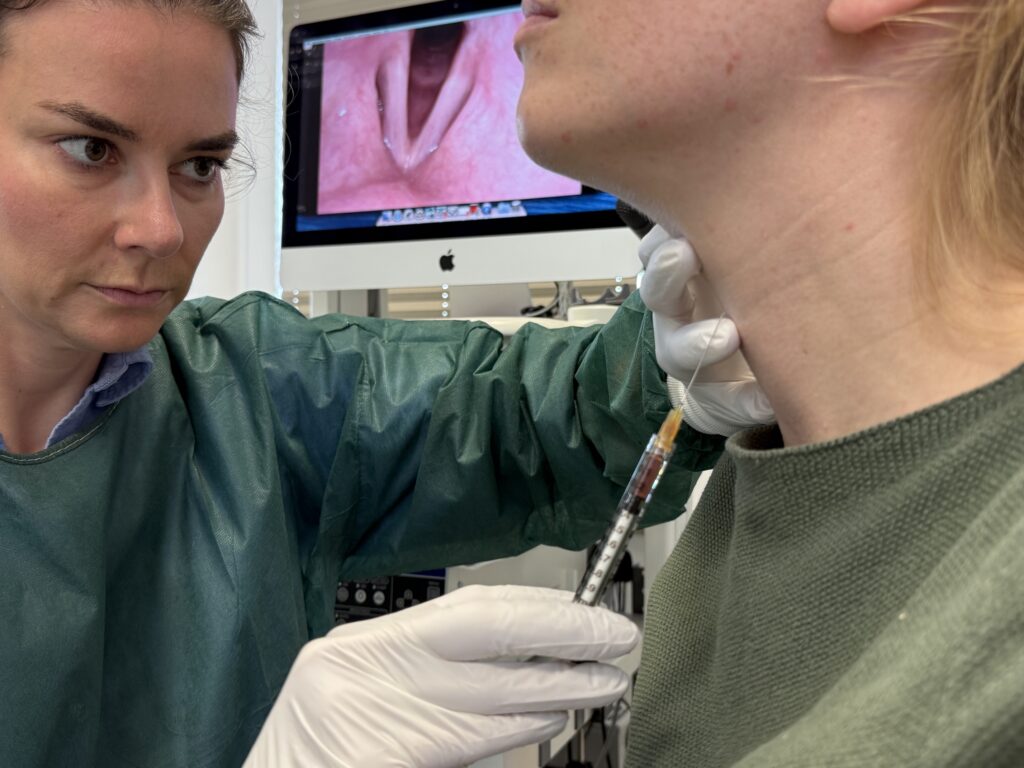
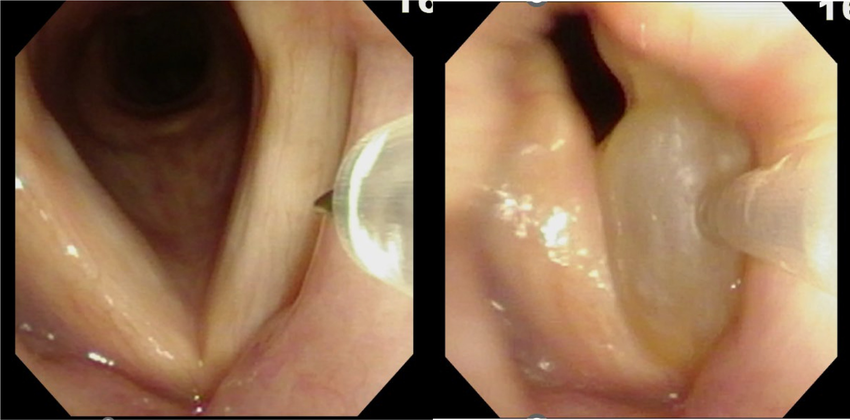
The appearance of the vocal folds pre- and post-platelet-rich plasma injection. The affected vocal fold undergoes a unilateral subepithelial injection of platelet‐rich plasma, resulting in superficial distension of the epithelium. Autor: Santa Maria et al.
Other Areas of Application
PRP is also increasingly being used:
• for functional glottic insufficiency (inadequate closure of the vocal folds)
• after surgery to promote healing
• for early degenerative changes in the vocal folds
• for voices subjected to heavy professional strain (e.g., singers, voice-over artists)
• in conjunction with other injection techniques
PRP Treatment Procedure (Outpatient, Minimally Invasive)
• Blood draw from a vein in the arm
• Preparation of the PRP (centrifugation, takes about 30 minutes)
• Targeted injection into the vocal fold (usually under local anesthesia, e.g., transnasally or percutaneously)
The injection usually takes only a few minutes and is performed without general anesthesia.
Benefits of PRP
• Use of the body’s own tissue → excellent tolerability
• Low risk of side effects
• Regenerative therapy rather than purely “filling” therapy
• Repeatable and combinable
Current State of Research
Scientific evidence is increasingly showing positive results, particularly in cases such as scars and the sulcus. However, this remains an evolving field.
Conclusion
PRP represents a promising addition to modern voice therapy. Especially in cases of structural changes to the vocal folds, it offers a biological, regenerative treatment option that goes beyond traditional methods.
Von der Rekonstruktion zur Regeneration
Besonders vielversprechend sind die Fortschritte im Bereich regenerativer Verfahren. Die klassische Phonochirurgie versucht, die Folgen von Stimmlippennarben, des Sulcus und der Stimmlippenatrophie zu kompensieren. Die regenerative Medizin verfolgt ein anderes Ziel: Sie möchte die geschädigte Lamina propria biologisch reparieren. Hier liegt möglicherweise die Zukunft der Therapie. In den letzten Jahren hat die Anwendung von Platelet-Rich-Plasma-(PRP) -Injektionen in den Stimmlippen besondere Aufmerksamkeit gefunden. PRP wird aus patienteneigenem Blut gewonnen und enthält hohe Konzentrationen verschiedener Wachstumsfaktoren
Quellen und Literatur:
- Woo, P. et al., Use of Platelet-Rich Plasma in Vocal Fold Scar, Laryngoscope Investigative Otolaryngology, 2021
https://onlinelibrary.wiley.com/doi/10.1002/lio2.620 - Bhatt, N. et al., Office-Based PRP Injection for Vocal Fold Pathology, Journal of Voice, 2023
https://www.sciencedirect.com/science/article/pii/S089219972200216X - Marx, R.E., Platelet-Rich Plasma: Evidence to Support Its Use, Journal of Oral and Maxillofacial Surgery, 2004
https://www.joms.org/article/S0278-2391(04)00811-1/fulltext - Hirano, S. et al., Regenerative Approaches for Vocal Fold Scarring, Current Opinion in Otolaryngology, 2020
https://journals.lww.com/co-otolaryngology/fulltext/2020/06000/regenerative_approaches_for_vocal_fold_scarring.6.aspx